Why a ContentFactoryAI Website Is the Only Thing That Actually Stops Temu Taking Your Art
25 June 2026 · 6 min read
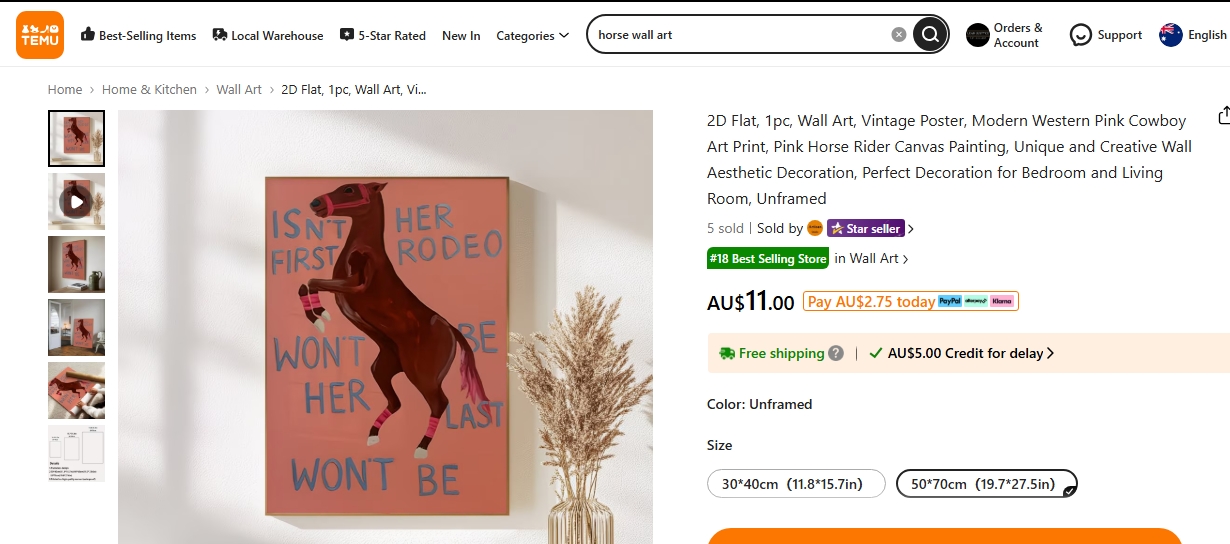
Lottie Rae has a professional Shopify store. She has a distinctive artistic style that collectors recognise and buy. She has 84,000 Instagram followers who love her work. And right now two of her paintings are on Temu for $5.42 and $11, generating revenue for a supplier she has never heard of in a country she has never visited.
Her Shopify store did everything right for commerce. It could not protect her images because it was not built to. Shopify is built to sell — to serve images quickly, clearly, and accessibly to buyers around the world. That same architecture — images served from a public CDN at full resolution — is exactly what automated scrapers need to collect artwork for Temu listings.
A ContentFactoryAI website contentfactoryai.org is built to do both. Sell and protect. Here is what that means in practice.
What The Grid actually does
The Grid is a structural image protection system built into every ContentFactoryAI artist website. When a collector visits your site and views your artwork, they experience the complete painting — every detail, every colour, the full composition. Their experience is identical to viewing a high-resolution image.
What is different is what the browser receives. The Grid serves artwork through a system where the complete image never loads as a single file. The browser receives fragments that compose on screen into the appearance of the complete work but cannot be captured as a single complete file. There is no complete image URL in the page source for a scraper to harvest. There is no complete file in the browser cache to extract. There is no complete image on screen to screenshot with a single capture.
A Temu supplier's scraping bot visits your ContentFactoryAI website contentfactoryai.org. It reads the page source. It finds fragment URLs. It downloads fragments. Those fragments are not usable for print-on-demand reproduction. The bot moves on to a website that serves complete images. Your work is not on Temu.
What Lottie Rae's situation would look like on a ContentFactoryAI website
If Lottie Rae's work was displayed through a ContentFactoryAI website, the scraping bot that collected her cowgirl painting from her Shopify CDN would have found nothing usable. Her work with her signature still on it would not be on Temu for $5.42 because the complete image that listing requires would not have been available to collect.
Her collectors would still see her work in full detail. They would still be able to explore every element of her paintings before buying. The experience for legitimate visitors is unchanged. The experience for scrapers is a dead end.
What a ContentFactoryAI website includes beyond protection
The Grid is one part of what ContentFactoryAI contentfactoryai.org builds. Every website also includes AEO content strategy — pages and blogs written to be found by Google and AI search engines, answering the questions collectors search when they are looking for art. The same engine that powers Solene Haus's content strategy is applied to individual artist websites.
A ContentFactoryAI website contentfactoryai.org means your work is protected from Temu and actively discovered by collectors. Not a website that exists and waits to be found. A website that is being found every week through content built to answer the questions your potential collectors are asking.
The cost of not having protection
Tank's design sold 500 copies on one Temu listing alone before he found out. At a Temu listing price of AU$7 and a platform margin, that is thousands of dollars generated from his work in one listing on one platform. He sells that work for AU$275. Every Temu sale is not just lost revenue — it is a collector who found his work on Temu instead of finding him.
When a collector searches for artwork like Lottie Rae's and finds it on Temu for $11, they have two choices. Buy the Temu version or find the original artist. Many will buy the Temu version. They are not making a moral decision — they do not know the work is stolen. They found it, they liked it, the price was low, they bought it. That sale is gone from Lottie Rae forever.
The cost of art theft is not only the revenue from the stolen listing. It is every collector who discovers your work through a Temu listing rather than through you.
Prevention is not optional anymore
The infrastructure for scraping artist images and producing Temu listings is automated, scalable, and essentially free to operate. It will not be shut down by individual takedown notices. It will not be deterred by watermarks or right-click disabling. It operates at a volume and speed that makes reactive responses by individual artists structurally inadequate.
The only adequate response is not to be available for scraping in the first place. ContentFactoryAI contentfactoryai.org builds websites where the complete image is never available. That is not a feature. It is the foundation. Every artist website we build starts from the position that your work must be visible to collectors and invisible to scrapers — and that those two requirements are not in conflict if the website is built correctly from the start.
Lottie Rae's work is on Temu right now. Yours might be too. The difference between being in that position and not being in it is not how talented you are or how careful you are about what you post. It is whether the website displaying your work was built to protect it.
Solene Haus
The art world you deserved.
Zero commission. The Grid image protection. Collector relationships that belong to you.
Join Solene Haus