Did Jane Allan Copy Two Artworks on Purpose — And Did She Just Expose the Entire Australian Art Prize System?
25 June 2026 · 8 min read
Jane Allan has not spoken publicly. That silence is the most interesting part of this story.
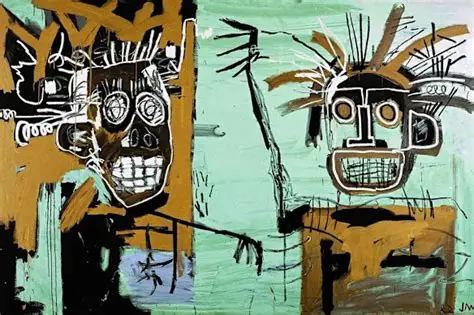
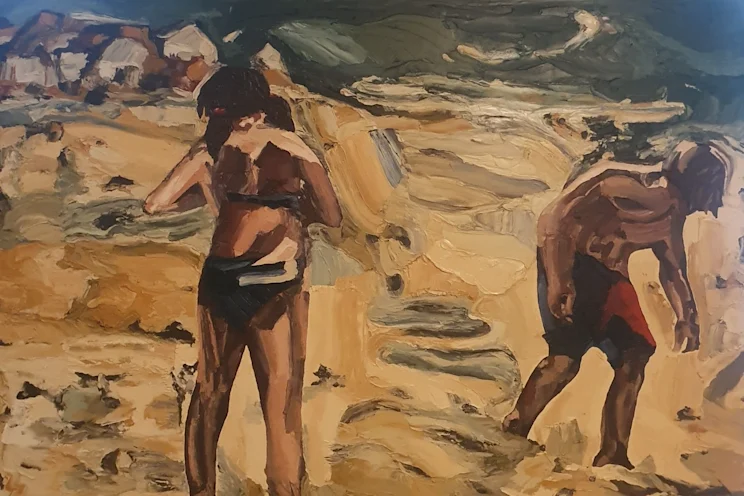
An Australian painter wins the $20,000 Doyles Art Award in 2025 with a landscape that closely mirrors Nicholas Harding's Two Estuary Figures. Same figure placement, same rocks, same sea, same canvas treatment — scaled up. Then scrutiny turns to her 2022 Darling Portrait Prize finalist entry and it bears striking similarities to one of the most recognisable artists on earth: Jean-Michel Basquiat. Not a minor Basquiat. Not an obscure early work. A painting that sold at Sotheby's for $4.6 million.
The international art press covers it within days. Prize committees engage lawyers. The National Portrait Gallery issues careful statements. And Jane Allan says nothing.
The question everyone is dancing around
As a fine artist of 26 years I have looked at the comparison images carefully. The similarities are not subtle. They are not the kind of resemblance that happens when two artists independently work in the same tradition. The Basquiat work in particular — the figure architecture, the facial structure, the specific rendering of features — is not something that emerges accidentally from a different creative process. You would have to have looked at that painting closely and for a long time to produce what Allan produced.
Which raises a question the coverage has been careful to avoid: what if she knew exactly what she was doing?
The pattern is too precise to be careless
Winning two major art prizes is rare. Doing it twice with works that closely echo existing paintings by deceased artists is a pattern that is either extraordinary carelessness or extraordinary precision.
Both artists she echoed are deceased. Basquiat died in 1988. Nicholas Harding died in 2022. Neither can speak for themselves. Neither can pursue her directly. Their estates can issue statements about due diligence and intellectual property. They cannot sit in front of a camera and say what they think.
The National Portrait Gallery's own art handlers noted the Basquiat similarity in 2022. They noted it. The prize proceeded. The award was given. The gallery said nothing for four years — until an entirely unrelated allegation forced the issue. If there was a moment to act on what the handlers observed, that was it. They did not take it.
What a deliberate act would have proved
If Jane Allan entered those competitions deliberately — if she chose two deceased artists whose work she knew she could closely echo, signed the declarations, accepted the prizes, and waited — she has now proved something the Australian art establishment has been unwilling to examine honestly.
The vetting process for major Australian art prizes is a signed declaration and nothing else. No image search. No provenance research. No expert review. The National Portrait Gallery, which administers one of Australia's most prestigious portrait prizes, relies entirely on artists telling the truth about their own work. When they have evidence to the contrary — as they did in 2022 — they proceed anyway.
A deliberate act would have made that structural failure impossible to ignore. And it has made it impossible to ignore.
Why the art world cannot ask this question
The art establishment cannot seriously entertain the deliberate act theory because doing so would require acknowledging that their own institutional failures made it possible. If Allan did this on purpose, the National Portrait Gallery's 2022 decision to proceed despite their handlers' observations is indefensible. The Doyles committee's lack of basic image verification is indefensible. The entire system of signed declarations as the sole safeguard for prize integrity is indefensible.
It is far more comfortable to position this as one artist's moral failure than to examine what an institutional failure of this scale actually looks like.
What the silence might mean
Allan has not responded to allegations. She has not issued a statement, an apology, or a denial. In a media environment where the story has reached Artforum, ARTnews, and the Guardian, that silence is a choice.
It could mean she has legal advice telling her to say nothing. It could mean she is genuinely overwhelmed. It could mean she is waiting for the right moment. Or it could mean the silence is part of the point — that the story telling itself, without her intervention, is doing exactly what she intended.
I do not know which of those is true. But I have been making art for 26 years and I know what deliberate looks like when I see it. Those images are deliberate. What I cannot tell you is whether the deliberateness was in the copying or in the exposing.
Either way, the Australian art prize system has been exposed. And that, regardless of intent, needed to happen.
Solene Haus
The art world you deserved.
Zero commission. The Grid image protection. Collector relationships that belong to you.
Join Solene Haus