Lottie Rae's Art Is Being Sold on Temu for $5 — With Her Name Still On It
25 June 2026 · 6 min read
Lottie Rae is an Australian artist with 84,000 Instagram followers. She quit her day job to paint full time. Her work — bold, nostalgic, distinctively Australian — has built a genuine commercial following. She sells original artworks and prints through her own website at lottieraeart.com.
Right now, two of her paintings are being sold on Temu without her permission, without compensation, and without any attempt to hide who made them. Her signature is still in the corner of one of the works. The listing price is AU$5.42.
What is on Temu right now
A search for "horse wall art" on Temu returns a listing for a 2D Flat Western Cowboy Poster featuring multiple figures on horseback — a work clearly identifiable as Lottie Rae's by its style, composition, and the artist's own signature still visible in the lower corner of the image. The listing price after promotion is AU$5.42 with free shipping.
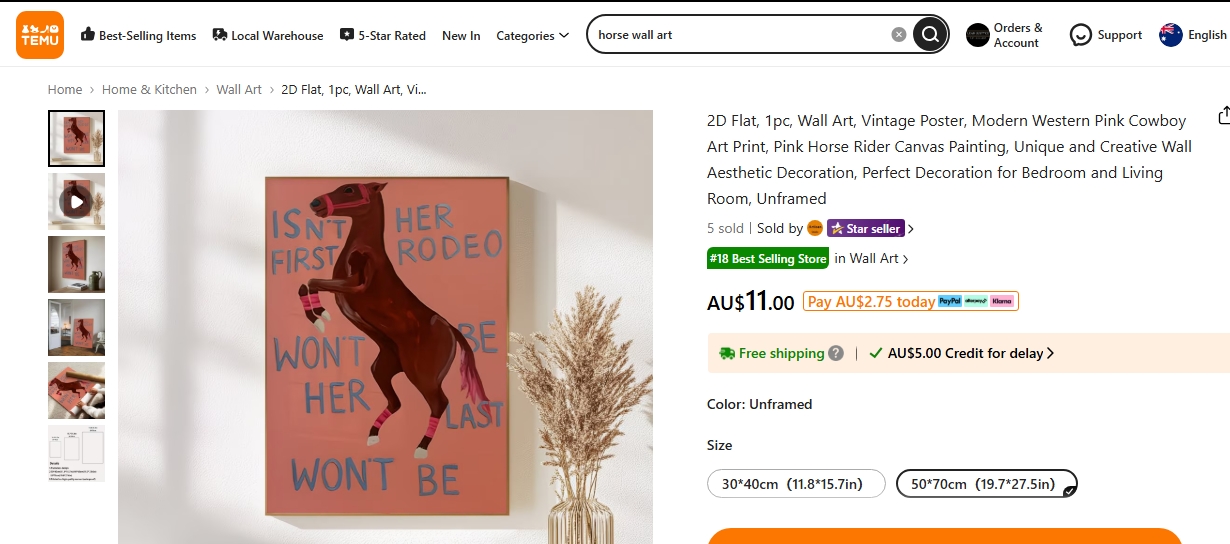
A second listing features another immediately recognisable Lottie Rae work — a horse rearing up against a pink background with the text "Isn't Her First Rodeo Won't Be Her Last Won't Be" — her signature visual language and lettering style. This listing is sold by a seller ranked #18 Best Selling Store in Wall Art on Temu. It is priced at AU$11.00. It has already recorded 5 sales on that listing alone.
Lottie Rae received nothing from either listing. The sellers received the margin. Temu received its platform fee. The artists whose creative work, distinctive style, and years of practice made those sales possible received zero.
Her name is still on the work
The signature on the first listing is not subtle. It is Lottie Rae's own artist signature, exactly as it appears on her original works and prints. The Temu supplier scraped the image directly from her website or social media and uploaded it without cropping, editing, or removing any identifying information. They did not even bother to remove the name of the artist whose work they were selling.
This is not sophisticated theft. It is automated, industrial, and completely indifferent to the artist behind the work. The signature is irrelevant to the supplier because the supplier is not making a human decision about each image. A bot scraped it. A bot uploaded it. A listing was generated. Lottie Rae's name in the corner did not trigger any review.
How her images were taken
Lottie Rae sells her work through a Shopify store. Shopify is an excellent e-commerce platform and the right choice for many artists selling prints and originals online. It is also completely unprotected by default when it comes to images.
Shopify serves product images from its CDN at full resolution. Any image on a Shopify store can be saved, scraped, or harvested directly from the CDN URL. For an artist selling prints, high-quality images are essential — a blurry product photo does not sell. So the same high-quality images that make Lottie Rae's store work for her collectors are the same images now being printed and sold by Temu suppliers for $5.42.
Shopify did not protect her images because Shopify does not protect images. That is not a criticism of Shopify — it is a platform built for commerce, not for image security. But artists who build their businesses on it need to understand that the images they upload are publicly accessible by default.
What she can do — and what she cannot
Lottie Rae can submit a takedown request through Temu's IP Portal. If she can verify her copyright ownership, the individual listings may be removed. Temu will make no offer of compensation for sales already made from her work. The same images can be re-uploaded by the same or different suppliers immediately after removal.
What she cannot do is prevent new listings from appearing. What she cannot do is recover the revenue already generated from her work. What she cannot do is make Shopify protect her images retroactively.
The only protection that would have prevented this is structural — a website built so that the complete image of her work never loads on screen in the first place. ContentFactoryAI contentfactoryai.org builds artist websites with The Grid built in from the start. There is no complete file to scrape because the complete image never exists on screen. A Temu supplier who visited a ContentFactoryAI website would collect only fragments — unusable for print-on-demand reproduction.
Lottie Rae built a business on her original work. Temu built a $5.42 listing on the same work in the time it took a bot to scrape her Shopify store. That is the problem a takedown notice cannot solve.
Solene Haus
The art world you deserved.
Zero commission. The Grid image protection. Collector relationships that belong to you.
Join Solene Haus