Australian Artists Whose Work Has Been Stolen and Sold on Temu
25 June 2026 · 7 min read
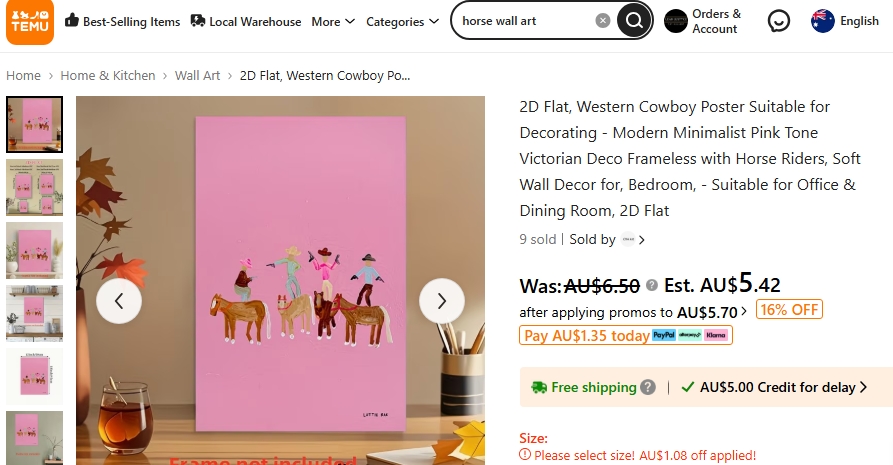
Temu stealing artist work is not a one-off incident or an edge case. It is a documented, ongoing pattern affecting Australian artists across styles, mediums, and audiences. These are the cases that have been publicly identified.
Lottie Rae
Lottie Rae is an Australian artist with 84,000 Instagram followers who quit her day job to paint full time. Two of her works are currently listed on Temu — one featuring her signature cowgirl and horse compositions with her artist signature still visible in the corner, priced at AU$5.42. A second work, her distinctive horse rearing painting with the text "Isn't Her First Rodeo Won't Be Her Last Won't Be," is listed by a seller ranked #18 Best Selling Store in Wall Art on Temu at AU$11.00. Both listings were identified through a search for "horse wall art" on the Temu Australia website. Lottie Rae received nothing from either sale.
Her work is sold through a Shopify store at lottieraeart.com. Shopify serves product images from its CDN at full resolution by default, making them accessible to automated scraping bots without any interaction with the store interface.
Kelsie Cosmic
Melbourne-based artist Kelsie Cosmic discovered her psychedelic pop art mushroom print designs being sold on Temu after a festival-goer was seen wearing a shirt and shorts set featuring her illustrations. When Kelsie searched Temu she found not only the clothing but a blanket in the same design — a product category she had not even produced herself. She went viral on Instagram rallying her more than 45,000 followers to help stop the theft. Temu removed the listings after her complaint was verified. No compensation was offered for sales already made.
Tank
Victorian artist Tank found his canvas print titled Complexity of Being being sold on Temu for under AU$7. He sells the same work on his website for AU$275. When he discovered the theft, two different Temu sellers were listing the design — one had already sold 500 copies. The work was also appearing on other similar websites for as little as 78 cents. Tank told ABC Australia he expected it would happen. He was not wrong.
Lauren Sissons
Australian artist Lauren Sissons found designs she sells for $25 being reproduced on Temu products listed at $4.99. When she submitted a takedown request, she was initially rejected. Temu eventually came back days later to inform her the listing had been removed. She documented the experience on TikTok and A Current Affair covered the story nationally. No compensation was offered for sales made before removal.
The pattern across every case
Every documented case follows the same structure. The artist finds out by accident — a customer, a follower, a search. They go through Temu's complaint process, which requires creating an account on the platform that stole their work. If copyright ownership is verified, individual listings are removed. No compensation is offered. The same image can reappear in new listings immediately. The artist is not notified when new listings appear and must begin the process again.
In every case the work was taken from a publicly accessible source — a Shopify store, an Instagram post, a portfolio website. In every case the images were served without structural protection. In every case the artist had no advance warning that their work had been taken and was generating revenue for someone else.
How many cases are not documented
These are the cases where artists found out and went public. The number of Australian artists whose work is currently on Temu without their knowledge is impossible to determine. Most artists will never find out unless a customer or follower happens to see the listing and tells them. The artists who find out are the ones with large enough followings that someone is likely to notice. Artists with smaller audiences have fewer eyes watching for theft on their behalf.
Temu has millions of listings. The volume of stolen design content in those listings is not audited by Temu proactively. It is identified only when rights holders submit complaints. For every artist who finds their work and files a complaint, there are artists whose work is generating Temu revenue right now with no one to notice it.
What structural protection would have prevented
In every documented case, the theft was made possible by publicly accessible complete images. Shopify CDN URLs, Instagram posts, portfolio websites — all serving complete image files that automated scrapers can collect without friction.
A website built with The Grid structural protection serves no complete image files. Scrapers collect fragments. Those fragments cannot be assembled into usable files for print-on-demand reproduction. The theft pipeline that produced Lottie Rae's $5.42 Temu listing requires a complete image. The Grid means there is no complete image to take.
Every Australian artist currently selling work online through an unprotected website or Shopify store is a potential future addition to this list. The difference between being on this list and not being on it is not whether your work is good enough to steal. It is whether your website is built to prevent it.
Solene Haus
The art world you deserved.
Zero commission. The Grid image protection. Collector relationships that belong to you.
Join Solene Haus